A threat assumption with practical consequences
At the Air & Space Forces Association conference, the Chairman described autonomous systems, pervasive tracking, and contested communications as conditions the joint force must prepare to face. He pointed to Ukraine, where he said some first-person-view drones use computer vision to continue toward targets despite lost GPS or communications. That is his stated battlefield observation; it does not establish that every drone has that capability or that a single technology defines the entire threat. Caine keynote transcript
The planning consequence is substantial. A defensive concept that depends entirely on interrupting an adversary's communications cannot assume that interruption ends every threat. Likewise, protecting a formation involves more than buying an individual counter-drone device. Command relationships, situational awareness, movement, logistics, and the training burden all affect whether a defensive capability remains useful outside a demonstration.
Force protection has to account for the range of behaviors a unit may encounter, including systems that continue operating when links degrade. That practical requirement matters more than declaring a single new threat assumption for every adversary.
Scarlet Dragon makes integration visible
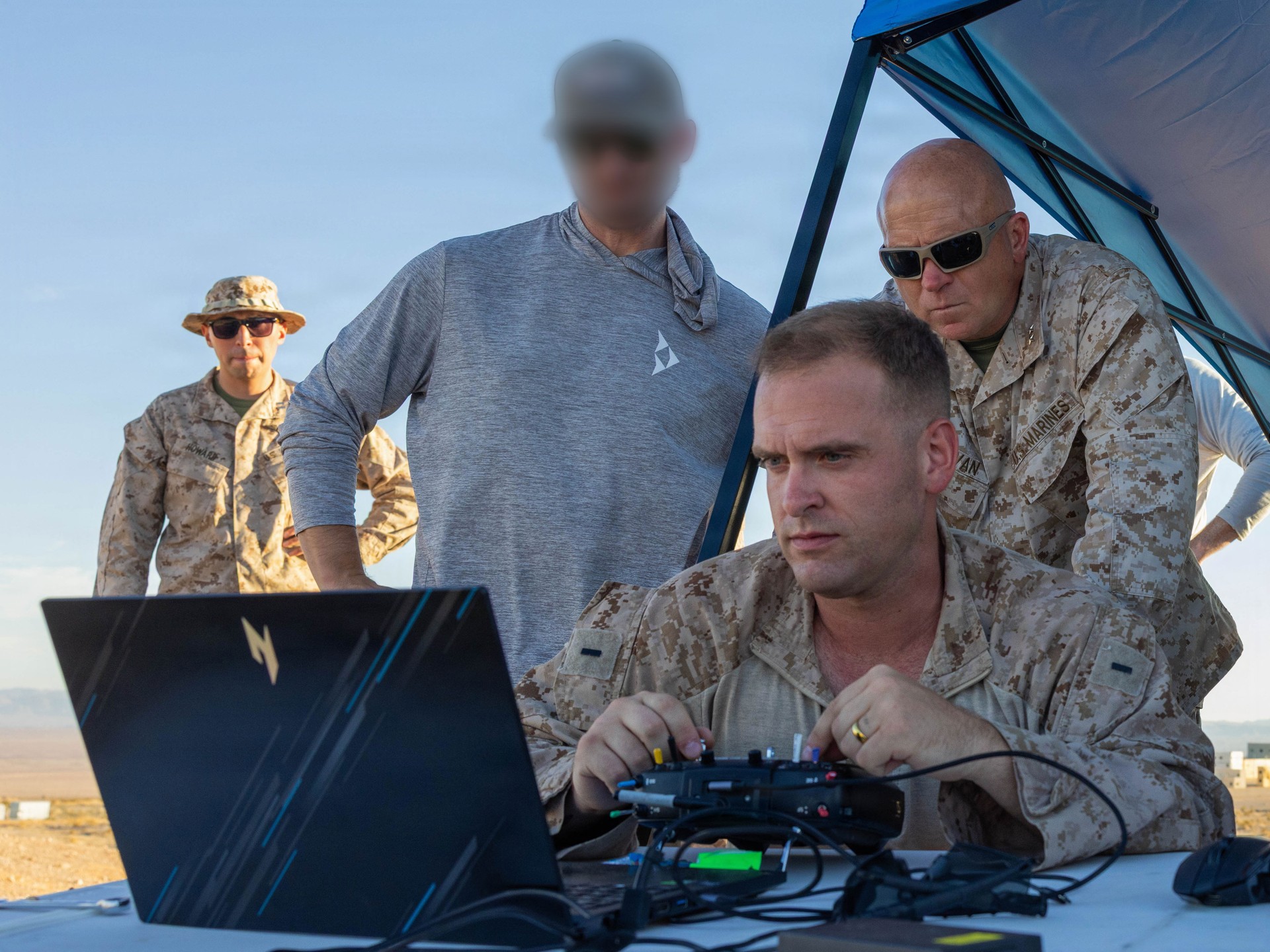
The Army's account of Scarlet Dragon 26-3 at Fort Bragg describes an operational stress test involving drone swarms of up to 100 aircraft. Its focus included how sensors, command-and-control systems, and air defense capabilities worked together. The exercise exposed soldiers to overlapping threats and gave developers operational feedback before systems reached wider fielding. Army exercise report
That is a useful form of evidence, provided its limits remain visible. An exercise report describes the test conditions and purpose. It does not establish a published defeat rate, prove performance against every adversary, or demonstrate that a capability is already available throughout the force.
For a program manager, the valuable output is the connection between an observed problem and a funded correction. Did an integration issue produce a configuration change? Did operators receive updated training? Will the next unit inherit the corrected version? Without that chain, repeated experiments can rediscover the same weakness while procurement continues on a separate schedule.
The defensive effort already exists
Replicator 2 specifically addresses small-drone threats, providing an established institutional effort on the defensive side of the autonomy portfolio. The Army's January 2026 announcement of its first Replicator 2 purchase is one concrete example of an existing defensive effort. Army Replicator 2 announcement
The harder management issue is how such efforts connect across services, locations, and operational requirements. An installation protection system, a deployed formation's requirement, and a corps-level experiment may share technology while needing different staffing, authorizations, support, and training. A program inventory should make those relationships clear before leadership assumes that one procurement solves all three.
Three questions help distinguish activity from readiness:
- Who owns the complete capability? Identify responsibility for the equipment, its integration, operator proficiency, and sustainment rather than treating delivery of hardware as completion.
- What carries forward from the experiment? Retain the tested configuration, known limitations, corrective actions, and evidence supporting each fielding decision.
- What can the receiving unit actually support? Account for personnel, maintenance, software changes, spares, and recurring training within its operating constraints.
Trust has to keep pace with updates
Autonomous defensive functions raise difficult questions about unintended engagements, operator understanding, and behavior outside tested conditions. DoD Directive 3000.09 requires appropriate human judgment over force and includes testing, verification, validation, training, and review requirements for systems within its scope. Its applicability depends on the system and use; it is not a single certification label that covers every AI product. DoD autonomy policy
Speed does not make verification irrelevant. It makes reusable test infrastructure, clear change control, and prompt access to evidence more valuable. A system that changes frequently needs a way to determine which changes affect previous findings and what must be reassessed before use. That requirement belongs in the program plan and supplier relationship from the start.
A sensible implementation sequence is to:
- Define the authorized use and the conditions the system is expected to handle.
- Establish the evidence and approval responsibilities needed before fielding.
- Connect operational feedback to tracked engineering corrections and regression testing.
- Preserve the version history, operator guidance, and limitations delivered to each unit.
- Budget for recurring assessment and support as the threat and software change.
These are program and assurance responsibilities. They help decision-makers understand what has been demonstrated, what remains uncertain, and who has accepted the residual risk.
Watch what becomes routine
Caine's warning is consequential if it changes everyday preparation: training access, supported equipment, integration work, and the resources assigned to units. Demonstrations are necessary, but they should lead to repeatable fielding and sustainment rather than become the principal evidence of progress.
Over the next eighteen months, the useful questions are whether units receive capabilities they can maintain, whether lessons travel between experiments and programs, and whether updates preserve a defensible basis for trust. That is how a leadership warning becomes an enduring institutional response.
Sources and further reading
- AFA: Gen. Dan Caine's September 16 keynote
- Army: Scarlet Dragon 26-3
- Army: first Replicator 2 purchase
- DoD Directive 3000.09: Autonomy in Weapon Systems
Spartan X brings AI, engineering, cybersecurity, and program execution perspectives to the transition from experimentation to dependable use. Connecting technical evidence with integration, training, and support decisions is central to that work.