What the Chinese research actually demonstrated
The Chinese Academy of Sciences Institute of Mechanics announced its result on March 9, 2026. Its system combines superconducting techniques, SQUID measurement and four test masses to suppress environmental interference. The report describes a hybrid mechanical-spring and superconducting suspension, rather than a frictionless sensor floating in isolation.
The institute reported gravity-gradient noise better than 0.02 E per square-root hertz at 1 Hz, where E denotes the Eötvös unit of gravity gradient. Its demonstrated gravitational signal came from a 10 kg object. The claimed comparison with large gravitational-wave instruments concerned weak-force resolution in a particular frequency band; it was not a comparison of submarine-detection range.
The stated applications included gravitational research, geophysics, hydrology and geology. The report supports continued attention to sensor development. It does not demonstrate moving-platform detection, persistent submarine tracking or a military deployment timetable.
Gravity is different from sound—but still has to be measured
Acoustic quieting reduces sound-related signatures. It does not directly remove gravitational effects. That makes gravity and gravity-gradient sensing worth studying alongside magnetic, acoustic and other measurements. It does not mean detection is unavoidable or that every acoustic countermeasure becomes operationally irrelevant.
A submarine is not an isolated mass added to empty space. It displaces seawater, and its density distribution matters. A 2026 theoretical hull-model study explicitly accounts for displaced water and identifies limitations in simpler mass models. The authors describe numerical analysis, acknowledge the absence of real-target field experiments and note that motion and marine interference were not fully incorporated.
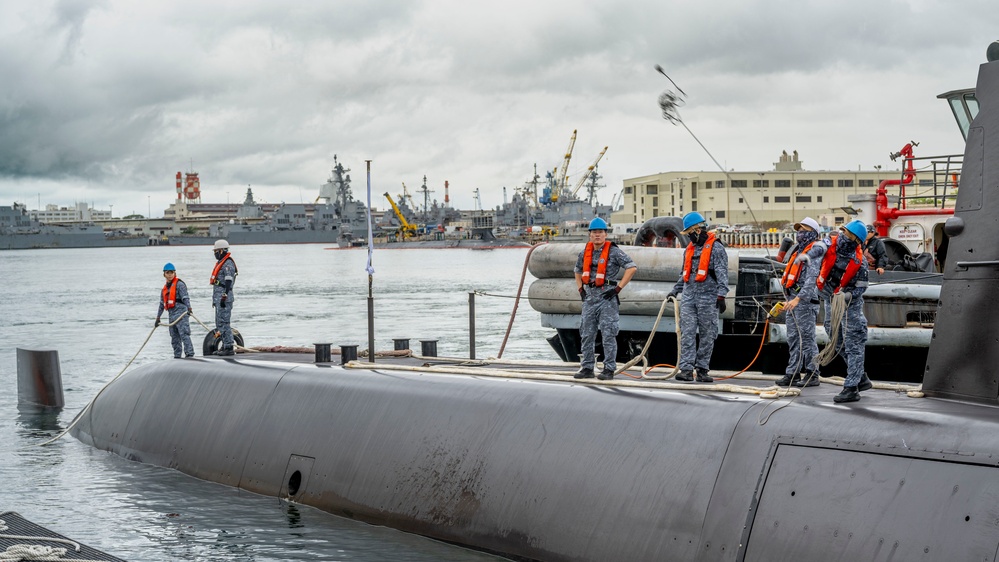
The Navy lists Ohio-class submerged displacement at 18,750 tons. That is a useful statement of vessel scale, not enough information to calculate a reliable detection radius. A credible assessment also needs geometry, separation, density distribution, measurement bandwidth and background conditions.
The sensor must distinguish a weak target-related signal from the environment. Research on seawater-density effects shows why ocean structure matters to gravity-gradient measurements. Platform acceleration, vibration, drift and uncertainty in the background can further complicate interpretation. Noise suppression under one set of conditions does not establish the same performance aboard a moving aircraft or vessel.
Assess the implications for deterrence in stages
Ballistic-missile submarines contribute to deterrence through survivability and the ability to retain a retaliatory capability. That value depends on much more than a single assertion of absolute invisibility. Detection, classification, localization, sustained tracking and the ability to act on a track are separate problems.
Improved non-acoustic sensing could affect parts of that problem if it becomes operationally useful. It would not automatically overturn the rationale for the United States' Columbia program, Britain's Dreadnought or France's sea-based deterrent. Nor should nuclear propulsion itself be equated with superior acoustic stealth under all conditions. Australia's AUKUS submarines are a conventionally armed capability with a distinct mission and should not be conflated with nuclear-armed SSBNs.
Quantum radar, magnetic sensing and gravity sensing also require separate assessments. A judgment about one cannot establish the maturity or ineffectiveness of another. The practical question is which sensor can deliver useful information, in which conditions, at an acceptable cost and with credible false-alarm performance.
A research agenda that produces useful answers
- Characterize realistic signatures. Use models that account for displaced water and plausible mass distribution, then validate them against physical measurements.
- Measure environmental limits. Compare stationary and moving-platform performance, including background variability and instrument drift.
- Test the detection task. Evaluate blind trials, false positives, missed detections and the ability to distinguish a target from unrelated anomalies.
- Evaluate processing honestly. Compare machine learning with established methods using held-out real data, rather than relying entirely on favorable simulations.
- Connect results to operational relevance. Explain whether a result improves cueing, classification or sustained tracking and what additional evidence is required.
AI-enabled processing may help separate patterns or combine observations, but it cannot recover information that the measurements do not contain. Simulated training data also carry assumptions about the target and ocean. Independent tests should challenge those assumptions before a confident model output is treated as a contact.
Countermeasure research should begin with a validated threat model. Concepts such as gravity-signature decoys remain speculative; there is no demonstrated solution here that justifies treating them as a procurement-ready response. Understanding the actual limits of sensing is more valuable than assuming either inevitable detection or an easy technical escape.
Sustained research and measurement can inform future design choices without declaring an unsupported decade-long countdown. The decision is to improve the evidence now, so changes in undersea sensing can be assessed early and in proportion to their demonstrated effect.
Sources and further reading
- CAS Institute of Mechanics weak-force measurement announcement, March 9, 2026
- Underwater gravity-gradient hull-model study and its stated limitations
- Seawater-density effects on gravity-gradient measurement
- U.S. Navy Ohio-class characteristics
Spartan X’s engineering and AI practices bring disciplined modeling, data assessment and integration analysis to emerging sensing problems, helping decision-makers distinguish promising physics from capability they can responsibly plan around.