Read the funding before sizing the factory
The detailed R-1 exhibit lists FY2026 DAWG funding at $225.9 million. Its FY2027 request combines $1 billion discretionary and $53.59965 billion mandatory funding, totaling $54.59965 billion. That is about 241.7 times the FY2026 figure. These are proposed budget resources, not announced contract awards or a guarantee that annual demand will remain at this level. FY2027 R-1, Defense-Wide line 115
The subsequent budget overview describes departmental funding of $1.45 trillion, a 44 percent increase against its FY2026 departmental comparison, which includes mandatory funding. That context matters: comparing only a prior discretionary appropriation with a proposed total would overstate the change on a mismatched basis. The April budget materials are supplemented here with later industrial announcements where identified. Budget overview
The same overview describes a $53.6 billion Drone Dominance investment spanning procurement, counter-unmanned systems, logistics, collaborative operation, and institutional capacity. Among its proposed allocations are $13.5 billion for a commercially integrated logistics network, $4.5 billion for collaborative operation at scale, and $4.3 billion for institutional systems and personnel pipelines. These overlapping presentations describe the request from different angles; they should not be added together as independent pots of money.
That funding mix is the important industrial signal. A force built around numerous autonomous systems needs an operating structure around the hardware. A company selling a vehicle should understand who will own the data, repair the vehicle, authorize software changes, and pay for recurring support.
Replicator already reached across domains
Replicator's original ambition covered attritable autonomous systems across multiple domains. Its maritime awards and collaborative-autonomy work preceded this budget request. DIU's November 2024 software awards addressed resilient command and control and coordination among heterogeneous systems, including operation with disrupted or limited connectivity. DIU's Replicator software awards
The practical progression is from accelerated acquisition toward a larger, supportable force. That takes more than repeating a successful demonstration. Common support arrangements, training, configuration control, and production discipline have to survive changes in the vehicle fleet and the threat.
The separate Drone Dominance Program offers a concrete example of a staged purchase model. Its February 2026 announcement invited 25 vendors into Phase I competition and described a $1.1 billion effort over four phases, with the goal of delivering hundreds of thousands of drones by 2027. The announcement anticipated approximately $150 million in Phase I orders after evaluation. These were program goals and planned orders at that point, rather than proof that the entire quantity had been purchased or delivered. Phase I announcement
A staged competition creates opportunities and risks for suppliers. An invitation does not secure every later phase. Tooling, hiring, component orders, and working capital should therefore be matched to a realistic progression from evaluation through accepted deliveries.
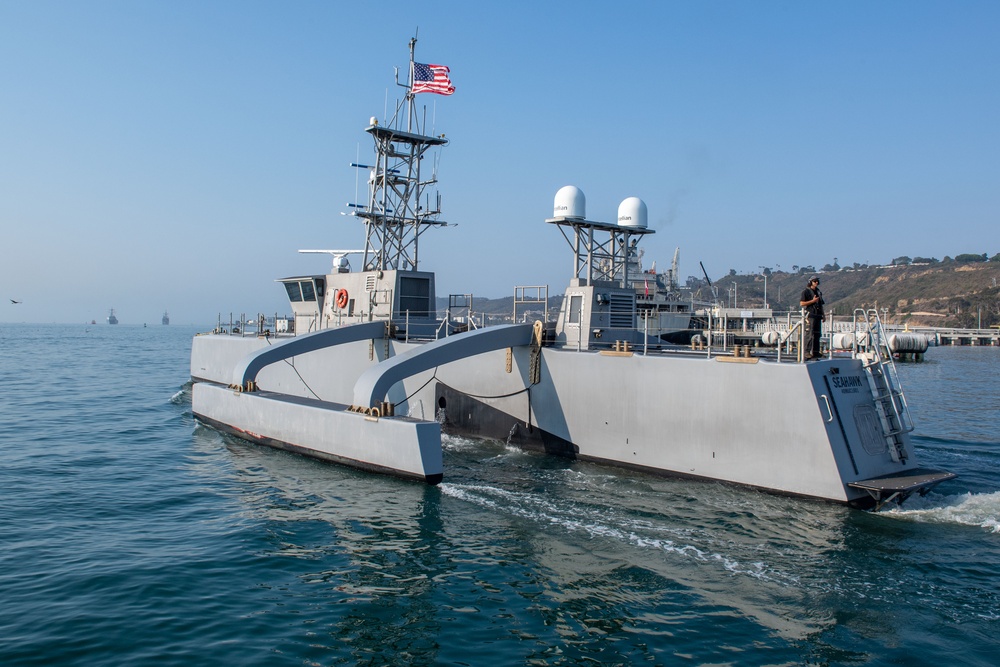
Maritime investment shows several production models
The industry's response is already visible, although private financing and supplier tests do not establish DAWG contract commitments.
- Saronic: the company announced a $1.75 billion Series D at a $9.25 billion valuation on March 31, 2026. In a later July 16 announcement, it selected Brownsville, Texas for the planned Port Alpha shipyard. Financing, site selection, construction, and operating production capacity are distinct milestones. Financing and Port Alpha
- Blue Water Autonomy: its February 11 announcement described the 190-foot Liberty design, developed with Damen, and planned construction at Conrad Shipyard beginning in March. Its May 7 update reported construction underway and described additional manufacturing partnerships. This combines an autonomy developer with established industrial capacity. Liberty announcement and May manufacturing update
- HII and Shield AI: HII reported a three-day integrated autonomy test aboard ROMULUS 20 in late October 2025. It demonstrated an integration milestone involving HII's Odyssey and Shield AI's Hivemind; fleet production and operational acceptance require additional evidence. HII test report
These approaches can coexist. New factories, established shipyards, and specialist software teams solve different parts of the problem. The commercial advantage belongs to teams that can turn their chosen model into predictable delivery and support.
Make integration and security measurable
Open architecture is valuable when a customer can replace or upgrade components without losing control of the system. The relevant interface standards, data rights, test requirements, and change authorities must be established for each acquisition. A broad autonomy budget does not itself impose a universal OMS or UCI interface, or establish that every platform must accept the same over-the-air update mechanism. Modular open systems approach
A useful supplier readiness review should answer five questions:
- Production: what rate has been demonstrated with qualified suppliers, inspection capacity, and realistic rework allowances?
- Integration: can an independent team use the documented mission, telemetry, and payload interfaces? What proprietary dependencies remain?
- Sustainment: who carries spares, manages batteries or propulsion maintenance, handles attrition, and supports deployed software versions?
- Cybersecurity: how are identities, update signatures, software provenance, and recovery controlled when connectivity is unreliable?
- Acceptance: what mission evidence and government approvals turn a delivered unit into an available operational capability?
CMMC addresses protection of covered contract information in applicable contractor systems; it is not a blanket certification of every autonomy model or embedded firmware component. Product security and mission authorization still need their own evidence. As later context, the July 13, 2026 CMMC update suspended the planned Phase II rollout while retaining Phase I, making current contract language especially important. CMMC program status
The budget request warrants serious preparation. It also rewards disciplined separation of appropriations, obligations, production capacity, and operational readiness. A resilient business plan can grow with funded demand without depending on every proposed dollar becoming a recurring order.
Sources and further reading
- FY2027 R-1 budget exhibit
- FY2027 budget overview
- DIU: Replicator software and collaborative autonomy
- Drone Dominance Phase I
- DoD modular open systems guidance
- CMMC current program information
Spartan X brings program execution, logistics, engineering, and cybersecurity together around this production challenge: connecting the acquisition opportunity to the interfaces, support arrangements, and delivery discipline that make an autonomous fleet usable.