The Selection Decision and What It Settled
The Army selected Bell Textron's V-280 Valor for the FLRAA requirement on December 5, 2022, choosing it over the Sikorsky-Boeing SB-1 Defiant. The Government Accountability Office subsequently denied Sikorsky-Boeing's protest. Bell's compliance with Modular Open System Architecture (MOSA) requirements — and the data rights terms the Army secured — was a decisive factor; the Army wanted the ability to use non-Bell suppliers for specific upgrades and sustainment activities, which the MOSA framework supports.
The aircraft was designated the MV-75 in mid-2025, with the "Cheyenne II" name announced at the Army Aviation Warfighting Summit in Nashville on April 15, 2026. The Army chose the name to honor the Cheyenne people and to tie the designation to the Army's founding year of 1775.
The requirements the MV-75 is designed to satisfy reflect the Indo-Pacific threat environment: Army Futures Command Commanding General James Rainey testified to Congress that the program needs to fly at roughly twice the speed and twice the range of current rotorcraft — a direct response to the tyranny of distance in any Pacific contingency. An air assault force operating from a ship or austere island base must reach objectives at ranges the UH-60 Black Hawk cannot achieve without staging or refueling infrastructure that may not exist or may be under threat. The MV-75's tiltrotor configuration — transitioning from helicopter-mode vertical takeoff to fixed-wing cruise — is the architecture that satisfies both requirements simultaneously. Published performance figures indicate a cruise speed exceeding 280 knots and a payload capacity of 14 soldiers or up to 10,000 pounds on an external hook.
What Milestone B Authorized
The Army achieved Milestone B on August 2, 2024, following a preliminary design review in April 2024 and an Army Systems Acquisition Review Council meeting in June. Milestone B authorized Bell to begin detailed design and manufacture of six engineering prototype aircraft under the EMD contract.
The current program of record, drawn from FY2025 budget estimates, projects approximately $844 million in RDT&E for FY2026, declining to about $827 million in FY2027 as procurement dollars begin to appear — $266 million in FY2027, rising to $439 million in FY2028 as Low-Rate Initial Production begins. The total projected investment in RDT&E and procurement through FY2029 is approximately $5.8 billion.
Six prototypes are a development fleet, not a production run. Milestone B's primary near-term purpose is proving that the detailed design choices — nacelle geometry, rotor hub design, cockpit systems architecture — can be manufactured and flight-validated. Each prototype carries a different instrumentation package, and test objectives are spread across multiple years. LRIP in 2028 follows demonstrated flight performance, airworthiness certification, and resolution of any design issues discovered during flight test.
In May 2025 Congressional testimony, Army leaders indicated they were examining options to accelerate initial fielding. The 101st CAB's designation as the first fielding unit converts every infrastructure, training, and sustainment decision at Fort Campbell into a direct schedule commitment.
The Training Gap: No Army Tiltrotor Tradition
The MV-75 will be the first tiltrotor platform in U.S. Army history. The Marine Corps has operated the V-22 Osprey since 2007; the Army has no equivalent institutional foundation. An aviator qualified only on the UH-60, Apache, or Chinook must fundamentally relearn how an aircraft transitions between flight regimes. Program documentation indicates the MV-75 will operate in fixed-wing cruise mode for the majority of most missions — behavior that rotary-wing pilots have never trained for.
The Army's near-term response has been cross-service familiarization with the Marine Corps' existing tiltrotor experience. Beginning in 2025, Army aviators from the FLRAA community gained familiarization flights on the MV-22 Osprey with Marine Medium Tiltrotor Training Squadron 204 at Marine Corps Air Station New River, North Carolina — specifically to generate doctrinal and training insights before the MV-75 arrives. The Army has also delivered virtual prototypes to Redstone Arsenal and Fort Rucker to begin building a training baseline.
In mid-May 2026, the FLRAA Project Office conducted a Special User Evaluation at Redstone Arsenal focused on the pilot display system and cognitive workload. A team of 101st CAB operators, engineers, and trainers tested the simulator cockpit to evaluate how the integrated display architecture manages information load during the transition from helicopter to airplane mode. The SUE results feed directly into detailed design and into the training manual that does not yet formally exist.
These efforts are appropriate for the current stage but are not a complete training pipeline. Army Aviation Center of Excellence will need dedicated MV-75 qualification syllabi, standardized instructor pilot programs, aircraft mechanic training for a platform with tilting nacelles, and maintenance publications — none of which can be finalized until flight test is further along. The compressed timeline from first flight to LRIP leaves limited margin for finding and correcting systemic training gaps before the first fielding unit receives aircraft.
Infrastructure: Fort Campbell's Planning Sprint
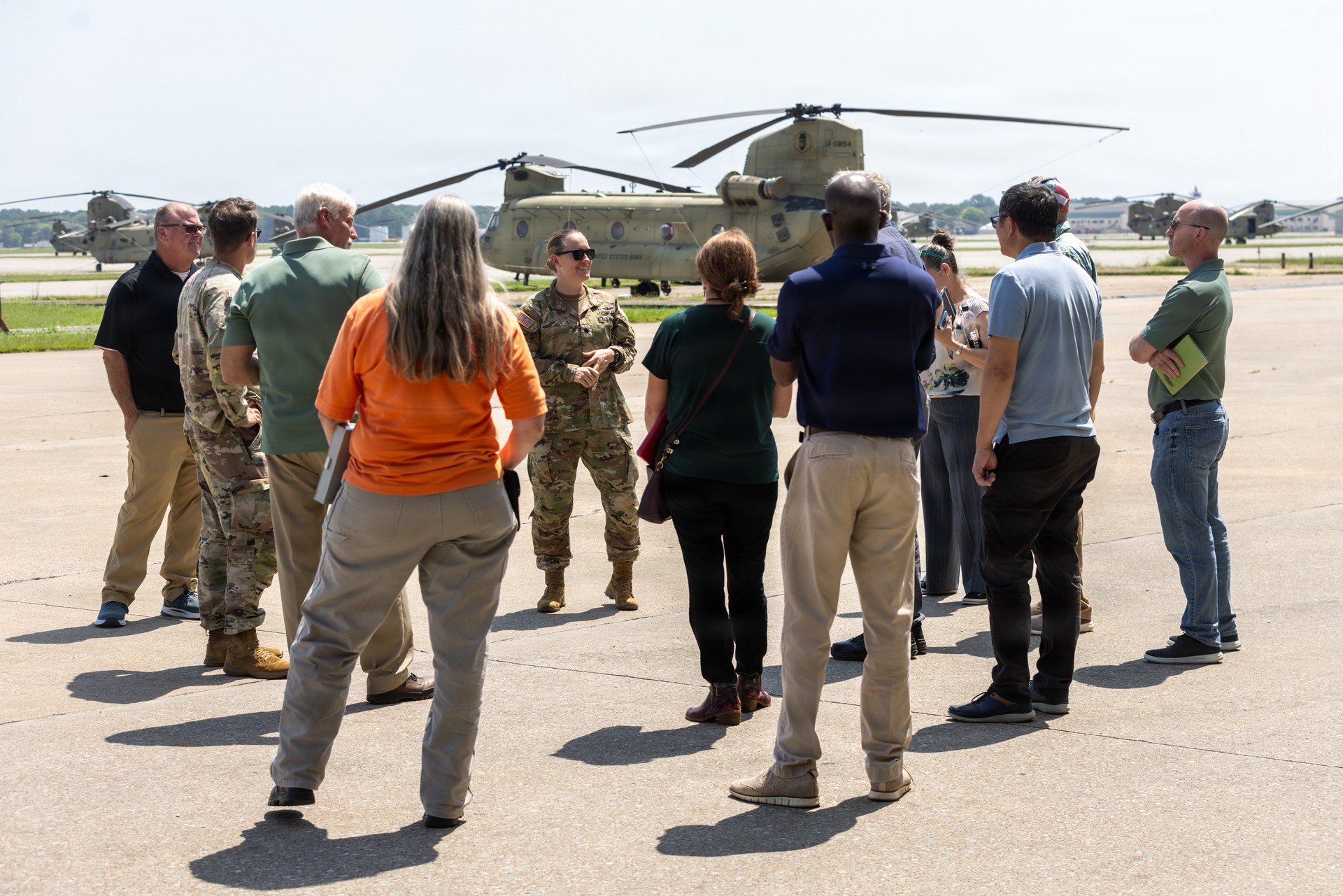
In July 2026, the 101st CAB hosted the Destiny Ramp Planning Conference at Fort Campbell — a three-day event bringing together 101st Airborne Division planners, PM FLRAA engineers, and U.S. Army Corps of Engineers representatives to map infrastructure requirements for MV-75 hangar and ramp facilities. Program representatives used augmented reality headsets to project virtual models of the aircraft onto the actual airfield, allowing planners to assess spatial requirements in context rather than from static drawings alone.
The conference highlighted a practical problem: the MV-75 is a fundamentally different aircraft from the UH-60 it replaces, and existing aviation infrastructure was not designed around it. Tiltrotor aircraft require different rotor clearance zones on the ramp, different hangar door geometry for nacelles in various positions, and different maintenance facilities to support proprotor assemblies and their conversion mechanisms. A facility designed for a Black Hawk does not automatically accommodate an MV-75.
The Destiny Ramp Planning Conference is the right approach — but its output must convert to funded Military Construction projects on a schedule that precedes aircraft delivery. Corps of Engineers MILCON project timelines for the scale of work Fort Campbell requires run three to five years from design to occupancy. If hangar facilities are not designed and included in the FY2027–FY2028 MILCON cycle, initial fielding aircraft will arrive at a unit that lacks adequate facilities to maintain them. The planning conference is a necessary precondition; funded design and construction is the actual requirement.
Sustainment and MOSA: Testing the Data Rights Terms
The Army's selection of the V-280 carried explicit MOSA compliance requirements, and the data rights terms negotiated with Bell are intended to give the Army competitive flexibility in sustainment and upgrades. MOSA compliance in the detailed design phase is not the same as MOSA compliance in a fielded and supportable product.
The practical test of whether MOSA terms return value to the taxpayer comes when a program executive office wants to award a third-party contract for a specific component or avionics upgrade and discovers whether the interface control documentation is genuinely usable by a second supplier — not whether the prime contractor's engineers can build it. Army acquisition personnel responsible for MV-75 sustainment should establish explicit MOSA validation criteria in EMD contract deliverables: criteria that test interface documentation against actual third-party supplier capability rather than against program office assurances.
The Army's initial EMD contract with Bell covers prototype delivery. Future sustainment, modification, and upgrade competition will be the vehicles through which the MOSA investment actually returns competitive value. Establishing the conditions for that competition now — through rigorous interface documentation review and early market surveys of potential second-source suppliers — avoids the common pattern of nominally MOSA-compliant programs that function as de facto sole-source sustainment contracts in practice.
What FARA's Cancellation Left Unresolved
The Army cancelled the Future Attack Reconnaissance Aircraft in February 2024 as part of FY2025 budget reductions, ending both Sikorsky's Raider X and Bell's 360 Invictus competition. FARA was intended to restore the armed aerial scout capability the Army gave up when it divested the OH-58D Kiowa Warrior in the mid-2010s as part of the Aviation Restructure Initiative. Neither the UH-60 nor the Apache fills that role with the speed, range, and signature the FARA requirement described.
The Army's working answer is that uncrewed systems — larger UAS programs in current development — will eventually satisfy the armed aerial scout requirement, and that the MV-75's speed and range partially compensate for the absence of a dedicated over-the-horizon reconnaissance platform. Whether that substitution is operationally sound depends on UAS program timelines and capability levels that are themselves in early development.
This is a legitimate risk that program managers and operational planners developing MV-75 employment concepts need to document explicitly. The assumption that UAS will be available to fill the FARA mission before the operational environment requires it should be stated as an assumption in planning documents — along with the contingency if it does not hold. MV-75 aircrews who may be required to perform reconnaissance tasks without a dedicated armed scout partner need training and doctrine that reflects that reality, not doctrine written for an order of battle that includes FARA.
Three Risk Factors to Watch Before 2030
The MV-75 fielding timeline has three realistic risk factors that program oversight should track against measurable interim milestones rather than headline dates.
Flight test performance. Six EMD prototypes will surface aerodynamic, structural, or systems issues that require design changes. Some will be minor; some could require redesign of components that affect the entire prototype fleet. The schedule from first flight to LRIP in 2028 is aggressive for a first-of-type aircraft, and a single significant finding requiring extended redesign resets the downstream schedule. The relevant interim milestone is not first flight — it is resolution of any major design findings before the LRIP decision.
MILCON timing. Fort Campbell's infrastructure projects must be designed, funded in the MILCON cycle, and constructed before aircraft arrive at the unit. The FY2027 MILCON submission is the key decision point. If the required facilities are not in that submission — or if Congressional action delays them — aircraft will arrive without maintenance facilities ready. Congress, HQDA G-4, and IMCOM need to treat FLRAA infrastructure as an operational readiness requirement, not a facilities support request.
Training pipeline maturity. The Army's tiltrotor training program is being built in parallel with the aircraft rather than ahead of it. If the first MV-75 instructor pilots have not completed a full qualification pipeline — including flight time in the actual aircraft — before initial fielding, the 101st CAB will build instructor capacity from its own operational aviators during a period when those aviators should be building unit readiness. That pattern has historically degraded readiness for the first two to three years of any new platform. The relevant milestone is the date the first class of qualified MV-75 instructors completes training at AVCOE, not the date aircraft are received.
Each of these factors individually can extend the 2030 IOC target by a year or more. In combination, they can push meaningful operational capability well past it. Congressional oversight staff, HQDA program managers, and the FLRAA Project Office should track each against interim milestones with ownership assigned now — not when the schedule is already stressed.
Spartan X's experience supporting complex defense acquisition programs — particularly in the planning and execution challenges that emerge when infrastructure, training, and sustainment preparation must develop in parallel with the platform rather than sequentially — gives the team direct familiarity with the decision points this kind of fielding timeline creates before program managers feel schedule pressure.
Sources and further reading
- Congressional Research Service, Future Long-Range Assault Aircraft (FLRAA), updated June 2025
- DVIDS, Army Announces Cheyenne Tribe Honored by MV-75 Helicopter, April 15, 2026
- DVIDS, Army receives feedback from Soldiers on the MV-75 Cheyenne's Pilot Display and Cognitive Workload, July 30, 2026
- DVIDS, U.S. Army Redstone Test Center is Ready for FLRAA, February 10, 2026
- DVIDS, FLRAA Achieves Milestone B, August 2, 2024
- DVIDS, Army Aviators Gain Tiltrotor Experience in MV-22 to Shape MV-75 Doctrine
- Army Aviation Digest, The Future Long Range Assault Aircraft Program, Winter 2026